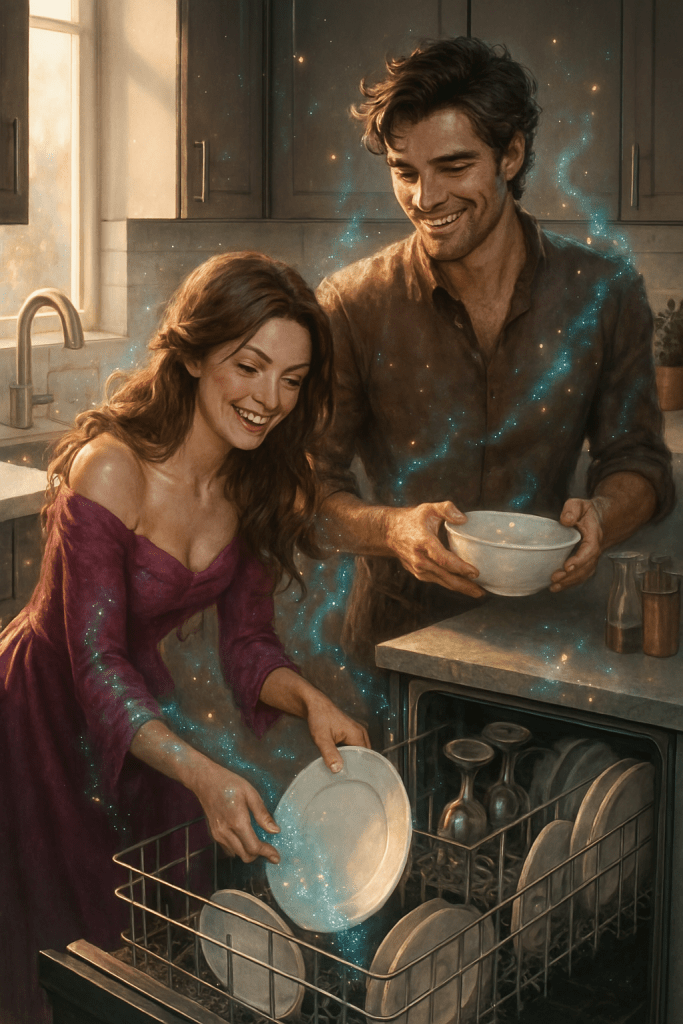
COUPLES in Romantasy often sense a connection between them, even when the way they’re both behaving and speaking suggests they’re enemies. For instance, for no reason she can make out, Mische from Carissa Broadbent’s The Songbird and the Heart of Stone, feels an intimacy between herself and Asar though they have only just met. Mortals also experience that strong sense of connection.
This powerful sense of belonging, intimacy or intense attraction is why we choose one potential partner over another. The one we pick offers the possibility to help us sort out issues from our past. For instance, a partner who seems attractively confident and together might turn out to be as stubborn and difficult to persuade as your dad. But you don’t realise that – if you ever do — until you’re deeply involved and the early relationship hormones have switched off.
The connection you have may be a mystery. You just feel an attraction, a special spark. There are often clealry identifiable reasons you’d get on. You’re pretty well aware of what you have in common (or not), of your physical attraction and the way your backgrounds do or don’t fit, but the certain something that makes this relationship special is not consciously recognised. It’s just a feeling or sense. Without it, though, the relationship would quickly fizzle out.
UNCONSCIOUS FIT
This is known as The Unconscious Fit, and it’s what gives relationships their potential for personal development. We see this in the way Romantasy characters often recognise how their new relationship is affecting their self-image and confidence, referring to changes that have occurred since they met and recognising ways their new love has helped them. In A Fate Inked in Blood, for instance, Freya realises that Bjorn is the only person in her life who doesn’t want to change her and even encourages the parts of her that have always been a problem previously. Bjorn tells Freya that the part of her he hates the most is the reason he loves her!
The slight downside to this is that sometimes this development can be a bit of a struggle. We’re confronted with qualities which seemed attractive and different when we met but which turn out to be surprisingly familiar. It’s as if we’re dealing with our dad’s lack of approval and our mum’s kindly but annoying intrusion all over again. Don’t think so? Then either you haven’t recognised this yet or you’re still full of hormones.
BICKERING, ARGUMENTS, THREATS AND BLAME
In new relationships, a powerful mix of hormones both bond us to someone special and prevent us from recognising their less attractive qualities. By the time we do, we’re deeply involved. Fortunately, we have the opportunity to do things differently, so we may negotiate a new way forward, enforce boundaries, experiment with new behaviours, think about it differently and adapt. It’s when we repeat the past, rather than learning from it, that relationships can become locked into toxic and repeating patterns. Though these can cause considerable pain, couples are often unable to quit. They sense there is still something to prove or learn but they never get there despite endless bickering, arguments, threats and blame.

Couples like these are often helpless to change because they usually blame their partner for everything that’s wrong in their life. Certainly, they’ll be triggering one another, bringing up memories of unhappy moments in their past. Often, it’s our bodies rather than our minds which remember these times. So the only sense we can make when our bodies are flooded with tension or pain is that our partner caused this. Intentionally.
Some people unconsciously attempt to manage difficult elements of their past by adopting some behaviours or personality traits of a carer or family member that were frustrating, scary or uncomfortable. In childhood, it’s sometimes easier to admire and adopt those characteristics and behaviours rather than trying to fight them, and we may continue this behaviour into adulthood too.
“Romantasy couples sometimes demonstrate thoughtful and caring behaviours that are too frequently missing in real life.”
By the time couples like this reach therapy, if they ever do, it’s often too late. There has been so much hurt, and so little nurturing and care, that they’ve both given up. The motivation to continue is all about point scoring, not love. On the other hand, couples who are curious about what’s going on between them and willing to experiment with changes are more likely to grow closer. Even if they experience many pinch points along the way, they’re motivated to support each other as well as valuing themselves and being clear about their personal boundaries, which helps them to negotiate their difficulties cooperatively. Romantasy couples sometimes demonstrate thoughtful and caring behaviours that are too frequently missing in real life. We often see them considering one another’s points, seeking consent or encouraging the other to look after themselves. We sense being in a relationship involves uncertainty for them too. They often have very difficult pasts, growing up as orphans, with cruel or sick parents or in circumstances of adversity, such as poverty or war. But, with their new partner, they feel like better people. They feel more able to be themselves, that at last there’s someone who will protect them and support them. With them they feel warm and safe. That’s what relationships should, and can, be like. TRT
 The Romantasy Therapist
Leave a comment